

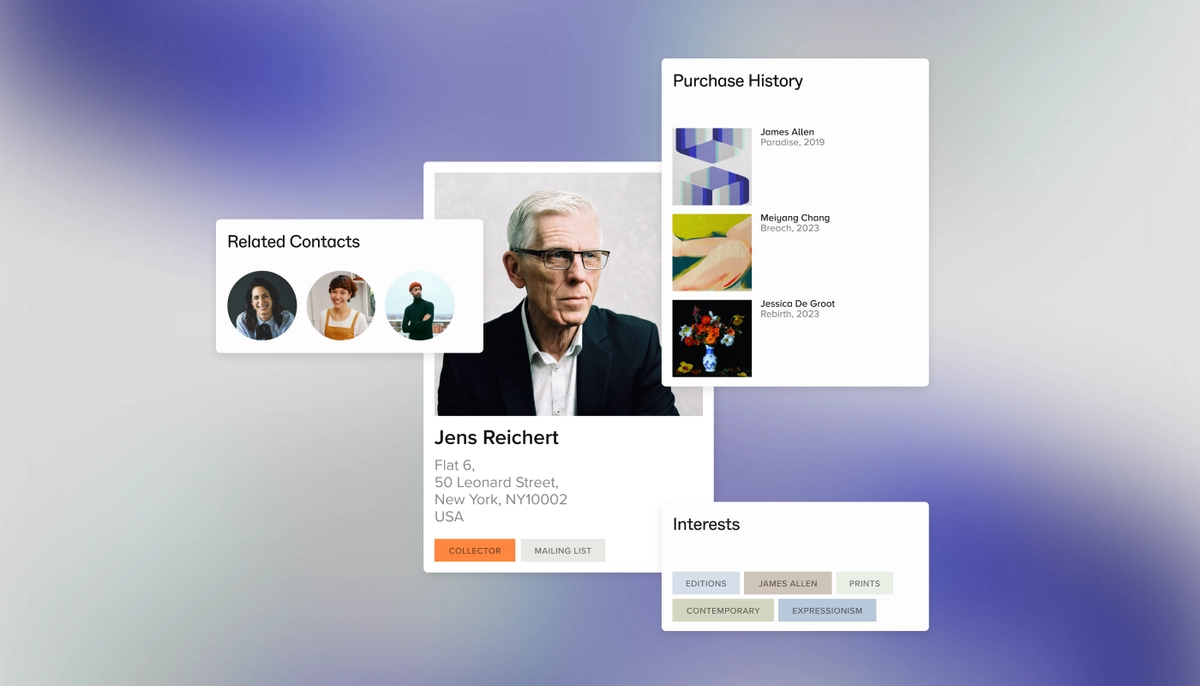
The systems used to manage collector relationships haven't kept pace. Paper notes, "I'll remember this tomorrow," and aging spreadsheets are still standard practice at many galleries, spread across a patchwork of disconnected tools: spreadsheets for contacts, inboxes for conversations, PDFs for artwork details, and separate platforms for marketing. The result is a fragmented view of the collector, one where no single system holds the full picture.
That fragmentation isn't just inefficient, it's costly. When information is scattered, it's harder to act at the right moment, with the right artwork, in the right way. As the market moves toward more omnichannel engagement, galleries need more than a place to store contacts. They need a system that reflects the full picture of each collector and helps move relationships forward.
The Problem With Traditional CRM Thinking
Most CRM tools were not designed for the art world. At their core, they function as structured databases. Storing names, deal stages, and last contact dates.
But collector relationships are not linear. They evolve through conversations, exhibitions, artwork preferences, and moments of discovery. When these signals are stored across disconnected systems, galleries are left managing what is effectively a “Frankenstack” , meaning they are spending time stitching together data instead of building relationships.
The shift is subtle but important: a CRM should not be something your team serves. It should actively support how you engage collectors. Here’s a brief comparison of some commonly known CRMs.
2026 CRM Comparison for Galleries
Takeaway
Tools like spreadsheets and email platforms support isolated tasks. But only an integrated system connects collector data, artworks, and sales into a single workflow.
A Practical CRM Framework for Managing Collector Relationships
A CRM is only as effective as the process behind it. The following framework helps galleries turn data into meaningful engagement.
1. Build a Living Collector Record
A collector record should evolve with every interaction.
Capture:
- Artwork and artist preferences
- Past acquisitions and price sensitivity
- Personal context (timing, motivations, relationships)
- Engagement history across fairs, exhibitions, and digital channels
This transforms the CRM from a static list into a working tool for sales.
2. Replace Lists With Segmentation
Generic outreach limits engagement. Segmentation enables relevance.
Group collectors by:
- Interest in specific artists or mediums
- Buying behavior and recency
- Level of engagement or responsiveness
This ensures every interaction feels considered, not broadcast.
3. Connect Outreach to Artworks
Collectors usually do not respond to generic messaging, they respond to artworks.
Instead of sending broad campaigns:
- Share curated selections tied to known interests
- Use tailored presentations for high-value collectors
- Align follow-ups with specific conversations or artworks
This reflects how collectors actually make decisions.
4. Track Momentum, Not Just Activity
The goal is not more emails, it is movement.
Track:
- Where each collector sits in the sales process
- What has been shared and when
- Which interactions lead to meaningful engagement
This helps teams prioritize time where it matters most.
From Data to Relationships
There is a broader shift happening in how CRM systems are evaluated. The question is no longer how many contacts you store or how many emails you send — it is whether your system helps you understand and engage collectors more effectively.
Galleries that rely on fragmented tools often spend more time maintaining data than using it. By contrast, a unified approach brings everything into one place, allowing teams to focus on conversations, context, and timing.
Why Specialized Art CRMs Win Over Generic Systems
Generic CRMs were built for sales pipelines, not for the way galleries actually work. A "deal" in Salesforce doesn't know the difference between a $2,000 print and a $200,000 painting, and it certainly doesn't track who painted it, where it's been, or who's allowed to see it. Art-specific platforms close that gap by building the gallery's actual workflow into the system itself.
- Artwork Context: Standard CRMs treat sales as abstract "deals." Art CRMs link interactions directly to high-res images, pricing histories, and artist notes, so every conversation with a collector carries the full context of the piece itself.
- Consignment & Provenance: They automatically log whether a piece is owned, on consignment from an artist, or on loan to a museum, keeping ownership status clear without manual cross-checking.
- Visual Logistics: They quickly generate essential industry collateral like invoices, wall labels, certificates of authenticity, and tear sheets, cutting out the hours galleries typically spend rebuilding these documents by hand.
The result is a system that reflects how galleries actually sell art, not a generic pipeline forced to fit around it.
Why Artlogic Reflects How Galleries Work
Artlogic’s CRM is designed as part of a connected ecosystem, linking collector data with inventory, marketing, and payments. This means every interaction contributes to a single, evolving view of the collector.
With tools like sales pipelines, Private Views, and integrated email campaigns, galleries can move from reactive communication to structured, informed outreach. And with reporting built around artworks and collectors, not generic metrics, teams gain a clearer understanding of what is working.
For galleries looking to move beyond spreadsheets and disconnected tools, Artlogic provides a practical, scalable foundation for managing relationships. Book a call with our team to see Artlogic in action, or try for free to explore how it can support your gallery.
Frequently Asked Questions
What is a CRM for art galleries?
A CRM for art galleries is a customer relationship management system designed to help galleries organize collector information, track conversations, manage sales opportunities, and maintain a history of interactions. Gallery-specific CRM platforms can also connect collector records with artworks, artists, exhibitions, purchases, and other information that shapes the sales relationship.
What should galleries look for in a CRM?
Galleries should look for a CRM that supports the way their teams actually build collector relationships. Important capabilities include detailed collector profiles, artwork and artist preferences, sales pipeline management, segmentation, follow-up tracking, reporting, and integrations with inventory, websites, email marketing, payments, and other gallery systems.
Why use a gallery-specific CRM instead of a general CRM?
General CRM platforms are typically built around standard sales processes rather than the relationship-driven nature of the art market. A gallery-specific CRM can connect collector activity directly to artworks, artists, acquisitions, exhibitions, and sales history, giving teams more context when deciding how and when to engage a collector.
Can a CRM replace spreadsheets for gallery contact management?
Yes. While spreadsheets can work for basic contact tracking, they become difficult to maintain as a gallery grows. A CRM provides a shared system where teams can update collector information, record interactions, segment contacts, track opportunities, and access the latest information without managing multiple versions of a spreadsheet.
How does a CRM help art galleries increase sales?
A CRM helps galleries identify opportunities and prioritize follow-ups by bringing collector preferences, sales history, conversations, and current opportunities together. Teams can use this information to recommend more relevant artworks, create targeted outreach, monitor where collectors are in the sales process, and make sure important conversations do not get lost.
Why are integrated gallery systems important?
Integrated systems reduce the need to move information manually between separate tools. When CRM, inventory, marketing, websites, and payments are connected, teams can work from a more complete view of each collector and spend less time maintaining fragmented data across different platforms.
Is Artlogic a CRM for art galleries?
Artlogic includes CRM capabilities within a broader gallery management platform, connecting collector information with inventory, sales pipelines, marketing, Private Views, payments, and reporting. This allows galleries to manage collector relationships alongside the artworks and activities associated with them.
Artlogic also supports the other side of those relationships. Artists and artist studios use Artlogic to manage their inventory, contacts, consignments, and sales, so they can keep track of which galleries hold their work and which collectors have bought it. Collectors, foundations, and corporate collections use Artlogic to catalog their artworks, record provenance and documentation, and manage their collections over time. Because galleries, artists, and collectors all work in purpose-built tools from the same company, Artlogic is designed around how the art world actually works, not the generic sales process of a typical CRM.
About the author
Andy Thorburn is Senior Product Marketing Manager at Artlogic, where he leads go-to-market strategy across the company's product suite. Since joining as Artlogic's founding product marketer, he has shaped how galleries and artists discover the value of Artlogic.