

















The Art Market Has Always Run on Relationships
The systems used to manage them, from paper notes and “I’ll remember this tomorrow” to aging spreadsheets, haven’t exactly kept pace.
Many galleries still operate across a patchwork of tools: spreadsheets for contacts, inboxes for conversations, PDFs for artworks, and separate platforms for marketing. The result is a fragmented view of the collector.
This is more than inefficient… It limits sales and growth. When information is scattered, it becomes harder to act at the right moment, with the right artwork, in the right way. As the market shifts toward more omnichannel engagement, galleries need more than a place to store contacts. They need a system that reflects the full picture of each collector and helps move relationships forward.
The Problem With Traditional CRM Thinking
Most CRM tools were not designed for the art world. At their core, they function as structured databases. Storing names, deal stages, and last contact dates.
But collector relationships are not linear. They evolve through conversations, exhibitions, artwork preferences, and moments of discovery. When these signals are stored across disconnected systems, galleries are left managing what is effectively a “Frankenstack” , meaning they are spending time stitching together data instead of building relationships.
The shift is subtle but important: a CRM should not be something your team serves. It should actively support how you engage collectors. Here’s a brief comparison of some commonly known CRMs.
CRM Comparison for Galleries
| Feature / Platform | Artlogic | Arternal | Art Galleria | Mailchimp | Spreadsheets |
| Built for the art market | Yes — designed for galleries | Yes | Yes | No | No |
| Collector profiles with artwork context | Deep integration (artworks, history, preferences) | Moderate | Moderate | Limited | Manual |
| Sales pipeline management | Full pipeline with tracking and follow-ups | Yes | Basic | No | Manual |
| CRM integration | Native and real-time | Partial | Limited | Yes | No |
| Website integration | Yes | Limited | Limited | Yes | No |
| Email marketing | Integrated with CRM data and artworks | Available | Limited | Yes (generic) | No |
| Private Views / tailored presentations | Yes — secure, artwork-specific | Some | Limited | None | No |
| Payments & invoicing | Built-in | External | Limited | Yes | No |
| Data insights | Art-specific reporting and analytics |
Available |
Limited | Campaign level insights | Manual |
| Collaboration | Multi-user, shared workflows | Yes | Varies | Yes | Yes, can be |
| Best use case | End-to-end gallery operations | Sales CRM | Lightweight management | Email campaigns | Basic tracking |
Takeaway
Tools like spreadsheets and email platforms support isolated tasks. But only an integrated system connects collector data, artworks, and sales into a single workflow.
A Practical Framework for Managing Collector Relationships
A CRM is only as effective as the process behind it. The following framework helps galleries turn data into meaningful engagement.
1. Build a Living Collector Record
A collector record should evolve with every interaction.
Capture:
-
Artwork and artist preferences
-
Past acquisitions and price sensitivity
-
Personal context (timing, motivations, relationships)
-
Engagement history across fairs, exhibitions, and digital channels
This transforms the CRM from a static list into a working tool for sales.
2. Replace Lists With Segmentation
Generic outreach limits engagement. Segmentation enables relevance.
Group collectors by:
-
Interest in specific artists or mediums
-
Buying behavior and recency
-
Level of engagement or responsiveness
This ensures every interaction feels considered, not broadcast.
3. Connect Outreach to Artworks
Collectors usually do not respond to generic messaging, they respond to artworks.
Instead of sending broad campaigns:
-
Share curated selections tied to known interests
-
Use tailored presentations for high-value collectors
-
Align follow-ups with specific conversations or artworks
This reflects how collectors actually make decisions.
4. Track Momentum, Not Just Activity
The goal is not more emails, it is movement.
Track:
-
Where each collector sits in the sales process
-
What has been shared and when
-
Which interactions lead to meaningful engagement
This helps teams prioritize time where it matters most.
From Data to Relationships
There is a broader shift happening in how CRM systems are evaluated. The question is no longer how many contacts you store or how many emails you send — it is whether your system helps you understand and engage collectors more effectively.
Galleries that rely on fragmented tools often spend more time maintaining data than using it. By contrast, a unified approach brings everything into one place, allowing teams to focus on conversations, context, and timing.
Why Artlogic Reflects How Galleries Work
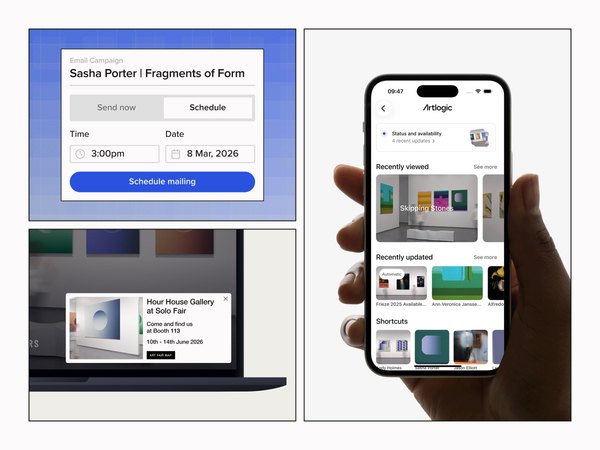
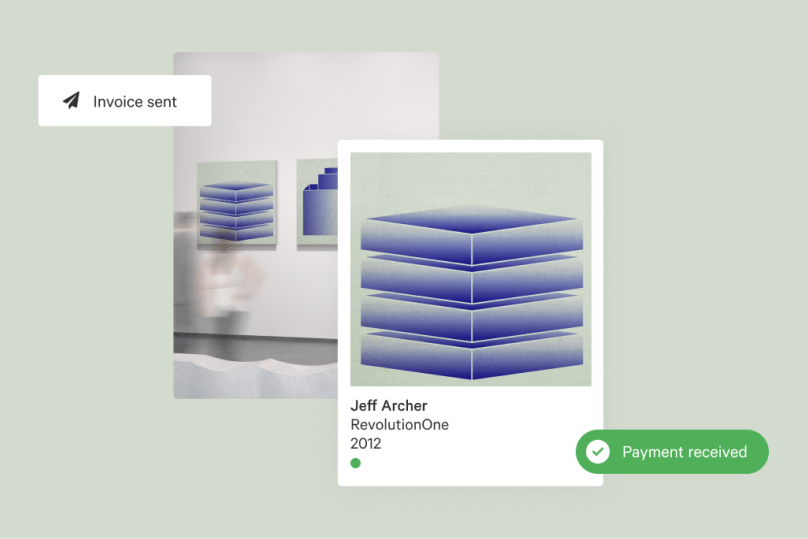
Artlogic’s CRM is designed as part of a connected ecosystem, linking collector data with inventory, marketing, and payments. This means every interaction contributes to a single, evolving view of the collector.
With tools like sales pipelines, Private Views, and integrated email campaigns, galleries can move from reactive communication to structured, informed outreach. And with reporting built around artworks and collectors, not generic metrics, teams gain a clearer understanding of what is working.
For galleries looking to move beyond spreadsheets and disconnected tools, this approach provides a practical, scalable foundation for managing relationships.
Read more
-

5 Website Best Practices for Selling Art in 2026
A gallery website is no longer a static digital brochure -
Artlogic Partners With Future Fair
A new on-site conversations program debuting in New York this May -
3 Essential New Features For Art Fairs
These new features help galleries stay prepared, communicate clearly with collectors, and present works with confidence, even on their busiest days.